

From Abandoned and Abused to Masters Degree
Remembering Mack, Part 1

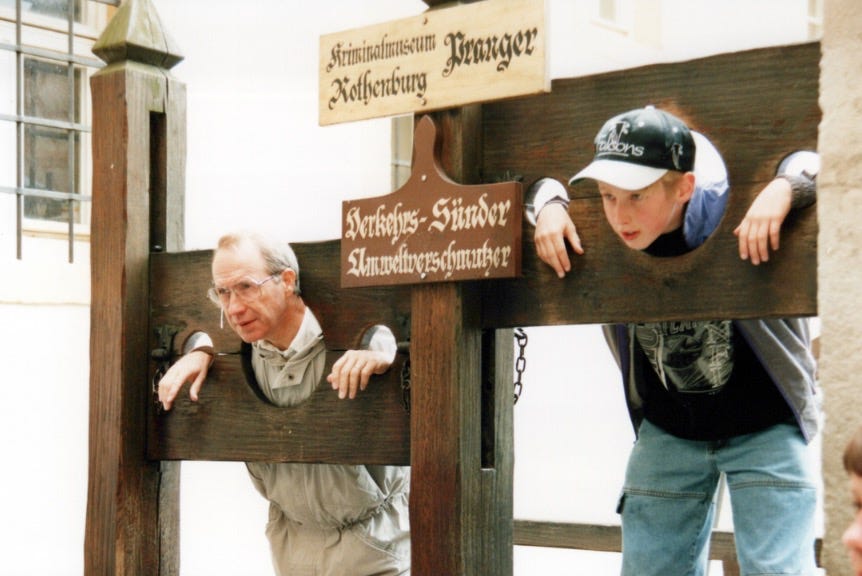
Our family was into stocks. Not so much the lucrative kind. This photo is of my late (2017) father, Mack, and my son, Seth, in the stocks in Rothenburg, Germany, in 1993.
Rumor has it our lineage on Dad’s side ended up in the pre-US British colonies when an ancestor (surname Geiger) lost a political skirmish in a Swiss canton in the early 1700s and fled with an entourage of close relatives.
The Geiger clan, if that trace is correct, fell far from their stint in Swiss canton leadership, eventually bottoming out as sharecroppers in South Carolina and Georgia.
The eldest of four siblings, Mack tried to keep his three sisters together, and away from abusive aunts, uncles, and cousins, after their parents abandoned them in a dusty south-Georgia town as World War II was winding down.
He was 12.
The ruse worked for some months, but when some teachers and neighbors became suspicious of their declining appearances, a home visit from a truancy officer put their scheme to an end and scattered the children to four different relatives’ ‘care.’ Each of their formative traumas would imprint them in different ways and telegraph through how they perceived their social realities and engaged with other humans.
After episodes of particularly brutal treatment by a relative, Dad ran away, from Georgia to Fort Lauderdale, Florida. He had heard his father, who was a grocer and World War II black market goods runner, was operating a vegetable distribution business.
Shortly after arrival, Mack was brutalized again.
He fled to the Everglades, then an even vaster, more majestic, and danger-filled swampland. He survived there for nearly two years on his own, subsisting on fish, crabs, and anything else he could catch. Eventually, an illness or parasitic infection caused fevers and rendered him lethargic. Already thin, he lost more weight. Through some combination of survival drive, resilience, and—Mom will comment if I don’t include it—divine intervention, he made it on foot back to Fort Lauderdale, where he passed out in an alley dumpster.
The Jewish proprietor of the business discovered the young teen in the dumpster. The man, or his Catholic wife (inconsistent in Dad’s tellings), nursed him back to health and offered to allow him to live in a lean-to shelter in the alley in exchange for helping in the business, attending Fort Lauderdale High School, and causing no trouble.
Despite missing over two years of school, Mack earned high grades, attesting to high intelligence. He made the basketball team. On a dare, he and some friends joined the Army Reserves to, “spend a weekend per month getting paid to play in the woods.” Almost immediately thereafter, the Korean Conflict kicked off and their unit was activated. It seemed they’d be spending time in different woods, doing the opposite of playing.
As it happened, they were reassigned to the 7th Army, in Germany, where Dad served as a personnel clerk in a signal battalion that strung communications lines through the Alps. Having been scouted during basic training in South Carolina, he played on the command basketball team, which racked up win after win.
1950 through 1954, a time when so many young men were sent into the meat grinder of Korea, was a magical time of belonging, healing, and new challenges.
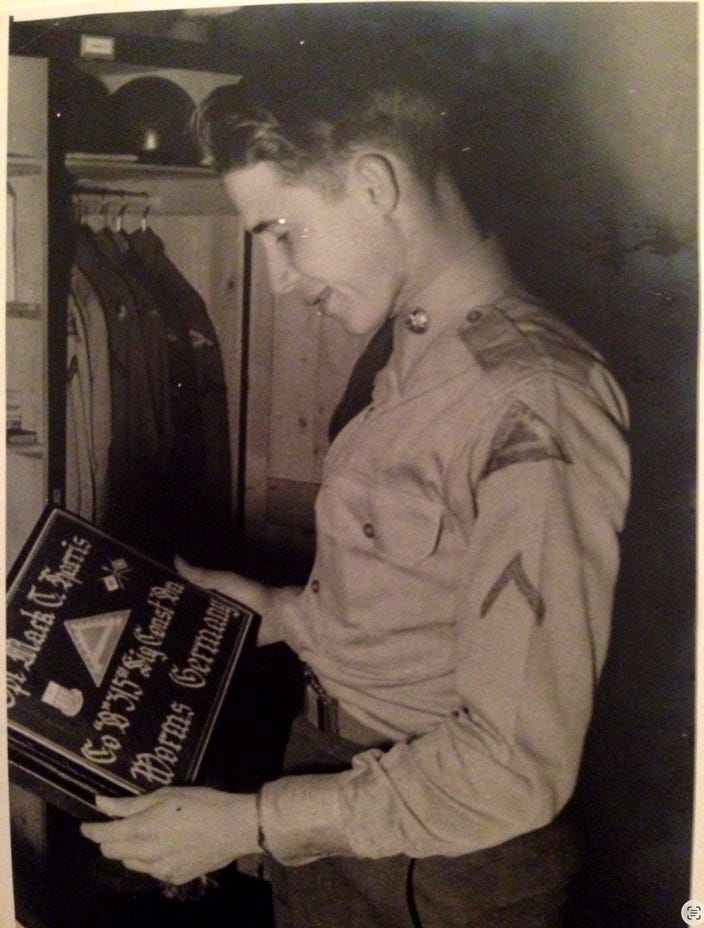
It was all more than he could have dared hope for until his battalion was ordered to implement the first instance of President Truman’s surprise command to racially integrate the Army.
His fellow white soldiers warned him there would be severe consequences for any soldier, even a friend, even a kid who was a sports star and an all-around favorite, who collaborated with Truman’s obscene edict.
The unit commander took extended leave.
The first sergeant got himself thrown into the stockade (jail) for gambling and trafficking military script (used during the German reconstruction, under the Marshall Plan).
It says something about the depth of white prejudice in 1953 that the threat of jail time and dishonorable discharge invoked less fear than facing vigilante justice from angry white peers.
Dad, at 21, was left with the bag:
Obey and risk being maimed or murdered?
Disobey and join the first sergeant in the stockade, which would mean a dishonorable discharge and loss of veteran’s benefits, most noteably the GI Bill, with its housing and educational benefits.
What did Mack do? That’s a story for my next article. (Wicked of me, I know.)
Today, it’s enough that you know Dad was
generous
loving
entangled in cultural, structural bias, yet fundamentally open to others despite surface differences
a storyteller
a fisherman (did I say, ‘storyteller’)
an inadvertently humorous communicator (oh, the hilarious gaffes)
a reader and scholar
a minister to the dispossessed
anti-hierarchy
a sports fanatic who would listen to one game on the radio while watching another on television
a lifelong basketball player who twice lost wedding bands during games and had a heart attack during a very long, elbow-throwing game against street players, on his 65th birthday
a table tennis whiz who routinely bested players decades younger and missed the Olympic doubles team by one elimination level (did I say, ‘storyteller’)
a passionate husband and father
a man who left tools, including nice lawn equipment, wherever he last used them
mentally ill, possibly with undiagnosed adult-onset schizophrenia
Dad died of dementia in January, 2017, after a long and gradual descent.1
But I won’t leave you with that image. No. Take this with you because it sums him up.
Dad could, and did, approach and talk with anyone, with no evident judgment of their ‘worthiness.’ People sensed his innocent sincerity (some called it naivete and gullibility) at a gut level and dropped their defenses.
He could not stand to see anyone being abused and, more than once, stopped whatever he was doing to intervene. He was not of intimidating stature, but a certain look in his eyes, firmness in his tone, and readiness in his stance prevailed in such encounters. I never saw a physical altercation ensue, but it was clear to anyone present that he would have stood his ground to aid another.
I miss Dad. While thinking of him this morning, sudden grief ambushed me and I cried. Cried for the first time since his death.
Whatever his formative years left him unable to give is insignificant compared with what he did give, which was everything he had.
Boundless thank yous to Mom, who stood by Dad through his highs and lows, driving nearly an hour each way to visit him frequently during his final five years in a dementia care facility. Love you, Mom!